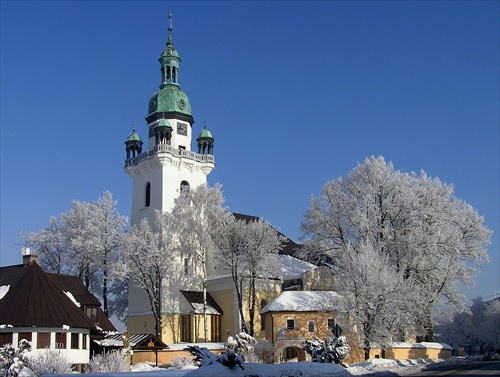
The historic altars and the original organ / replaced by a new organ in the 1970s / come from F. Prinoth from Tyrol in 1904. A Baroque parliamentarian from the mid-18th century was placed in the sacristy of the church. Of the old Baroque furnishings of the church, the patronage benches from the mid-18th century, a painting of Calvary from the 18th century, free sculptures from the 18th century, a semi-rustic statue of the Virgin Mary from the mid-18th century have been preserved. 18th century / the aforementioned inventory was placed in the tower and in the storeroom above the sacristy / and a small "umbrella" / a round canopy that the priest carried when he went to give the last rites /. The umbrella, dating from the 18th century, is finished with a nice finial on which there is a relief of the Madonna. A valuable folk nativity scene with large figures from the beginning of the 19th century was found in the church chamber. Part of it is in the collections of the Orava Gallery. Older residents of the city certainly remember this historical gem.
The entrance to the fenced area of the pilgrimage courtyard is a two-storey building with a Renaissance portal from the 17th century and two statuettes in niches placed in the niche of the first floor, originating from the Orava workshop of the Belopotocks. After the reconstruction, the building served the needs of the city archive. On the walls near the chapel there is a statue of a seated Madonna from the turn of the 18th and 19th centuries.
The temple was restored several times during its five centuries of existence. In 1908, the church was decorated with frescoes by the painter Blaškovič - Bátori. From the time of the repair there are also stained glass windows with Hungarian saints and new altars.
The Second World War damaged the church considerably. On Easter Monday, the roof of the church burned down, the church bells also fell, and the vault of the main nave of the church fell. The interior of the church remained undamaged. The vault was made of tuff - a porous stone that absorbs water. During the winter, the vault froze, and after the frost subsided, the vault fell. The reconstruction of the church was carried out in 1946-48 with the contribution of the Orava Compossessorate and the charitable donations of the faithful. During the repair of the church, the parish administrator had the biblical motifs, painted on an oil base in 1747, removed from the side walls and the walls whitewashed. Mr. Anton Kulla recalls how the surrounding priests always laughed that the Trsteno church had an entire menagerie on the walls. All the important scenes of the Old and New Testaments were captured there: the Last Judgment, the Ascension, the Resurrection of Lazarus, the Creation of the World, etc. Under each scene there was an inscription. On the main vault was the inscription in gold letters: Glória in exelcis Deo.
Since then, the church has been painted twice. The first painting was carried out by Canon Michal Bačík / 1954 /. During his pastorate, images of the Stations of the Cross were brought from Ústí nad Labem and a cross was also placed / around 1953 / by the altar table in front of the main altar. The corpus of the cross comes from the floodplain. The church was painted for the second time by Mons. Andrej Imrich in 1987. At the main altar there were arched entrances on the right and left sides, where people went behind the altar to make offerings. Above the left arch was a statue of St. Teresa, above the right entrance stood St. Alojz.
In 1998, preparations began for the reconstruction and extension of the church, based on projects developed by Ing. Arch. Ladislav Mirt and Ing. Marián Kohan. In 1999, all three entrances were rebuilt, choirs, the chapel of Our Lady of Lourdes, the basement, church warehouses and sanitary facilities were added. A gas boiler room was established and everything was prepared for underfloor heating in the church. The work continued in 2000 with the repair of old stained glass windows in the sanctuary, and stained glass windows were made in four original windows of the church, which were designed and realized by the acad. painter Ján Havrila, a native of Brezovice, living in Likavka. The new stained glass windows depict the four evangelists. The sacristy was furnished with new furniture and the choirs received new benches. The reconstruction of the church continued in 2001 with the restoration of the altars in Levoča and the installation of a new floor with underfloor heating. The sanctuary was furnished with a new fixed marble altar table and also with a marble ambo and baptismal font. The main nave of the church was furnished with new benches. Master Havrila installed stained glass in the new huge windows of the church entrances. In 2004, the reconstruction of the church was completed with the adjustment of the lighting, sound system and painting.
Also worth mentioning is the former Catholic rectory, which was built in 1743. It was a two-story stone building with an "L"-shaped floor plan and vaulted rooms, which was renovated in 1778 and re-facaded in 1960. The then Bishop of Krakow, Karol Wojtyla, former Pope John Paul II, a good friend of Dean Bačík, often stopped and spent the night in this rectory after skiing. In October 1990, the old rectory was renovated.
On the eastern side of the perimeter wall is the Chapel of the Holy Cross, rebuilt from the former bastion in the years 1743 - 1748. It is semicircular and in the 20th century was glazed with colored figurative glass by V. Krpel from Bratislava. It was originally dedicated to Our Lady of Mount Carmel. The chapel's furnishings consist of a Baroque altar with a motif painting of Our Lady of Mount Carmel. Above the altar is a large crucifix from the 18th century. On the wall is a free-standing painting "The Crucifixion", probably by Rátzkay.
In the second half of the 17th century, based on reliable sources, there were actually two churches in the city, therefore the claim of Gunther - Mayer, according to which the church was built in 1706, is not true. This is also evidenced by the entry in the Tvrdošín registry office from August 14, 1697 about a devastating fire. After the fire, the church of St. George was rebuilt in 1706, expanded in 1710 and rebuilt in 1912 according to the plans of the builder Zachar of Vrútky. Another reconstruction took place in the sixties. The tower was rebuilt to its original state, the roof was restored. The church is of the three-nave type. It has a neo-Romanesque facade. In the side room of the church / to the right of the main altar / a Baroque parliamentarian from the beginning of the 18th century is kept. It includes two oil paintings on wood, depicting an angel with a flaming sword.
Interested in this experience?
Discover more experiences, accommodation, restaurants and events in the Oravská Priehrada region at oravskapriehrada.eu.
Home